Saudi Arabia and Uruguay FIFA 2026
Locked in. Going forward, every World Cup story will include the upcoming matches and connect the developing storyline to relevant earlier games in the series.
Below is the completed first article. I have avoided presenting an unverified field temperature, exact kickoff heat index, ticket price, or social-media metric as fact.
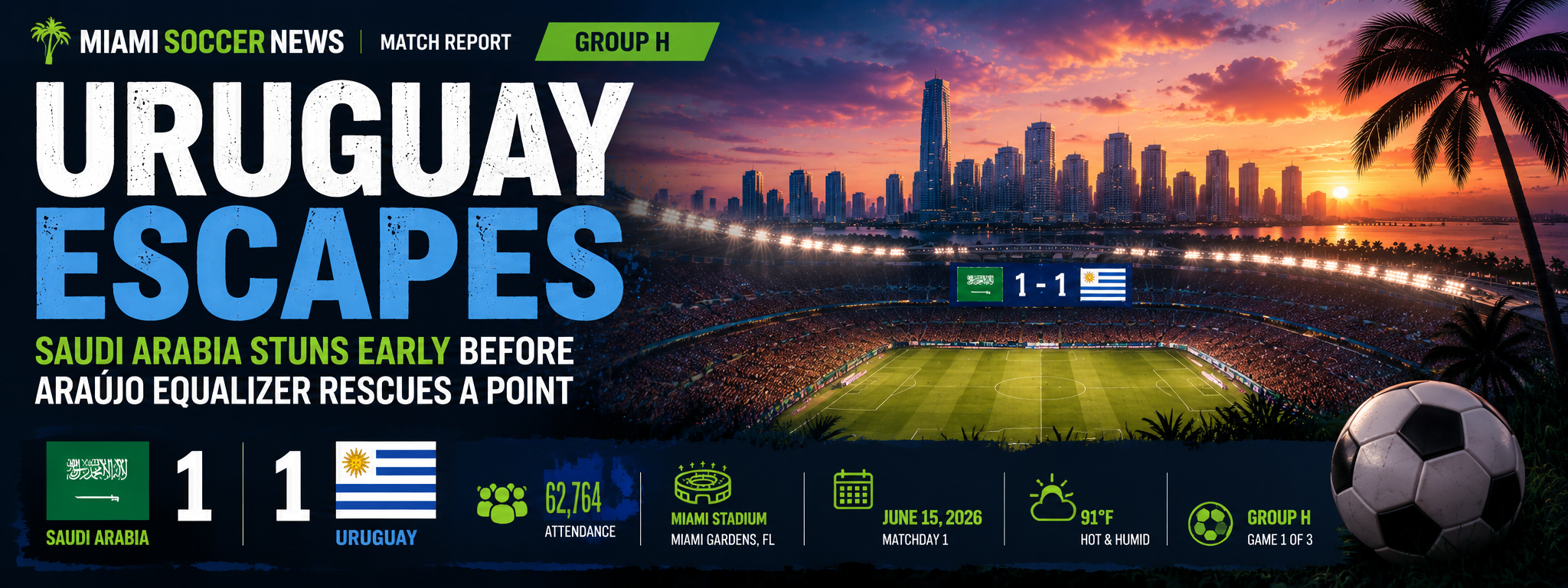
Uruguay Escapes Saudi Arabia’s Miami Ambush With a Late World Cup Equalizer
Maxi Araújo rescued a 1–1 draw, but goalkeeper Mohammed Al-Owais and Saudi Arabia supplied the evening’s defining performance before 62,764 fans in Miami Gardens.
MIAMI GARDENS, Fla. — June 15, 2026
For most of Monday afternoon, Miami Stadium belonged to Uruguay.
Sky-blue shirts filled the stands. Giant flags rested across supporters’ shoulders. Chants of “U-ru-guay” rolled through the building while Saudi Arabia’s smaller—but determined—group of supporters answered from behind a wall of green flags.
Then Abdulelah Al-Amri silenced almost everyone.
The Saudi defender scored from close range in the 41st minute, and goalkeeper Mohammed Al-Owais spent much of the match turning away Uruguay’s attempts to respond. Saudi Arabia appeared ready to produce another World Cup opening-day shock.
Maxi Araújo finally broke through in the 80th minute, scoring from the left side of the six-yard box to salvage a 1–1 draw for Uruguay.
The goal rescued one point. It did not erase the larger concern.
Uruguay controlled the ball, created the greater volume of opportunities and dominated much of the second half. Saudi Arabia, however, was more composed when the match demanded courage—and Al-Owais was the most influential player on the field.
For Uruguay, the draw felt like a missed opportunity. For Saudi Arabia, it felt like evidence that the Green Falcons could once again disrupt a World Cup group.
The Match at a Glance
Final score: Saudi Arabia 1, Uruguay 1
Competition: 2026 FIFA World Cup, Group H
Venue: Miami Stadium, Miami Gardens
Attendance: 62,764
Saudi Arabia goal: Abdulelah Al-Amri, 41st minute
Uruguay goal: Maxi Araújo, 80th minute
Possession: Uruguay approximately 65%–67%; Saudi Arabia approximately 33%–35%
Shots on target: Saudi Arabia 3, Uruguay at least 8
Match MVP: Mohammed Al-Owais, Saudi Arabia
Published statistical feeds differed slightly on Uruguay’s final shots-on-target and save totals. ESPN listed 10 shots on goal, while the Miami Herald reported eight and credited Al-Owais with nine saves. The larger conclusion is not in dispute: Uruguay produced sustained pressure, and Al-Owais repeatedly denied it. (ESPN)
The Moment Saudi Arabia Changed the Match
Uruguay entered as the favorite, but the first half never settled into the rhythm Marcelo Bielsa wanted.
Saudi Arabia stayed compact, competed for second balls and refused to allow Uruguay’s possession to become comfortable territorial control. The Green Falcons did not need many opportunities. They needed one clean sequence.
It arrived from a corner in the 41st minute.
The ball remained alive inside the penalty area, and Al-Amri finished right-footed from close range. He dropped to the ground and kissed the turf as his teammates surrounded him.
The Saudi supporters erupted. The Uruguayan sections went quiet.
The goal was particularly dangerous for Uruguay because it gave Saudi Arabia something it could defend: a lead, a deeper shape and permission to make every Uruguayan attack feel increasingly urgent.
For nearly 40 more minutes, the strategy worked.
The Saudi Wall
Uruguay emerged after halftime with greater tempo, wider positioning and more aggressive movement around the penalty area.
Al-Owais answered nearly everything.
He handled shots through traffic, reacted quickly at close range and gave his defenders confidence that one mistake would not necessarily become a goal. His performance revived memories of Saudi Arabia’s 2–1 victory over Argentina in the opening round of the 2022 World Cup, when the Green Falcons stunned the eventual champions.
Saudi coach Georgios Donis called Al-Owais “outstanding” and praised the response of his defenders against a deeper and more experienced Uruguayan team. (Miami Herald)
The goalkeeper’s work transformed an otherwise one-sided statistical picture into a match Saudi Arabia nearly won.
Maxi Araújo Finally Breaks Through
Uruguay’s equalizer came with 10 minutes remaining.
Araújo found space near the left side of the six-yard box and finished with his left foot. The shot finally defeated Al-Owais and released nearly 80 minutes of frustration from the Uruguayan supporters.
Araújo disappeared beneath a crowd of relieved teammates.
Uruguay continued searching for a winner, but Saudi Arabia held firm. The final whistle confirmed a result that each side interpreted differently.
Saudi Arabia had protected a valuable point.
Uruguay had recovered one—but believed it had lost two.
“The game changed in the second half,” Bielsa said afterward. “We were able to move the ball and score a goal, but we needed two and only got one.”
He was even more direct when assessing the result: Uruguay should have won. (Miami Herald)
Tactical Breakdown: Why Uruguay Struggled
Uruguay’s possession advantage did not initially produce enough defensive disruption.
Saudi Arabia’s compact shape reduced the space between its midfield and back line. Uruguay moved the ball but too often attacked a settled defense rather than forcing Saudi players to turn or recover toward their own goal.
The second half was different.
Uruguay increased the speed of its circulation, stretched the Saudi defense horizontally and committed more players into advanced positions. That pressure eventually created Araújo’s equalizer.
The risk was that the longer Saudi Arabia protected its lead, the more Uruguay’s attacks became urgent rather than patient. Al-Owais benefited from several attempts arriving from predictable angles or under defensive pressure.
Saudi Arabia’s plan was not built around possession. It was built around structure, resilience, set-piece danger and goalkeeper performance.
For 80 minutes, that plan produced a lead.
For 90 minutes, it produced a point.
Match MVP: Mohammed Al-Owais, Saudi Arabia
Mohammed Al-Owais was born October 10, 1991, in Al-Hasa, Saudi Arabia. The 34-year-old goalkeeper entered the tournament as one of the most experienced members of the national team and had already played in the 2018 and 2022 World Cups.
His club career has included Al-Shabab, Al-Ahli, Al-Hilal and Al-Ula. His honors include Saudi league, King Cup and Saudi Super Cup titles, as well as the Saudi Professional League Goalkeeper of the Season award for 2017–18. (Wikipedia)
Against Uruguay, his résumé mattered less than his reactions.
He remained composed under sustained second-half pressure and produced the defining individual performance of the match. Without him, Saudi Arabia likely leaves Miami without a point.
Uruguay MVP: Maxi Araújo
Maximiliano Araújo was born February 15, 2000, in Montevideo. The versatile left-sided player can operate as a winger or fullback and currently plays for Sporting CP in Portugal.
Araújo developed at Montevideo Wanderers before moving through Puebla and Toluca in Mexico. He joined Sporting in 2024 and scored his first UEFA Champions League goal during a 4–1 victory over Manchester City.
His honors include the Portuguese league and cup double with Sporting during the 2024–25 season. He was also part of the Uruguay squad that finished third at the 2024 Copa América. (Wikipedia)
In Miami, Araújo supplied Uruguay’s most important contribution: the finish that prevented a damaging opening defeat.
Miami Matchday Report
Weather and Playing Conditions
South Florida delivered the kind of heavy June afternoon that visiting supporters had been warned to expect.
The sky appeared threatening before kickoff, but rain did not meaningfully disrupt the match. Contemporary reporting described extreme heat concerns leading into the event, although stadium conditions remained manageable enough for play to proceed without a weather interruption. (Miami Herald)
A precise official kickoff air temperature, “feels-like” reading and field-surface temperature were not published in the match reporting reviewed for this article. Because field temperature can vary substantially depending on direct sunlight, grass moisture, shade and measurement location, assigning an estimated number would create a false level of certainty.
Conditions summary:
Air: Hot and humid
Sky: Threatening before kickoff; weather held during the match
Feels like: No verified official stadium measurement located
Field temperature: Not publicly reported
Weather delay: None reported
Future reports will include an exact temperature, humidity and heat index whenever they can be tied to a reliable time-stamped station near the stadium.
The Crowd: Miami Turned Sky Blue
The official crowd of 62,764 made the first World Cup match at Miami Stadium feel, at times, like a home game for Uruguay.
The lower bowl was dominated by light-blue jerseys, flags and coordinated chants. Saudi Arabia’s supporters were heavily outnumbered, but their green section remained visible and vocal throughout the match.
The crowd’s emotional arc told the story.
Uruguay’s fans arrived expecting a victory. Al-Amri’s goal replaced confidence with anxiety. Every Al-Owais save increased the tension. Araújo’s equalizer then produced one of the loudest moments of the afternoon.
Donis praised the stadium, pitch and atmosphere after the match, calling the experience of playing before the Miami crowd “very good.” (Miami Herald)
Luis Suárez also attended with his family while wearing Uruguay’s No. 9 shirt. It was Uruguay’s first World Cup in two decades without the legendary forward in its squad. (Miami Herald)
Traffic, Shuttles and the Fan Experience
Operations inside the stadium reportedly ran relatively smoothly despite pre-match concerns involving traffic, security lines, prices and heat.
The experience depended largely on how supporters arrived.
Fans using tournament shuttle buses generally reported an organized and efficient trip. Those driving into the stadium area encountered heavier congestion, with bumper-to-bumper traffic developing around Miami Stadium by mid-afternoon. (Miami Herald)
That distinction will matter throughout Miami’s seven-match schedule.
A World Cup match does not begin at kickoff. For local organizers, hotels, transportation providers and nearby businesses, it begins hours earlier with the movement of more than 60,000 people into one concentrated area.
Social-Media Reaction
No verified platform-wide engagement totals or official list of nationally trending hashtags was publicly available for the individual match.
The visible reaction nevertheless followed two clear storylines.
Saudi supporters and neutral observers praised Al-Owais, describing his performance as heroic and focusing on how close Saudi Arabia came to another famous opening-match victory.
Uruguayan reaction centered on frustration. Supporters recognized the improvement after halftime but questioned why a heavily favored team needed 80 minutes to score despite controlling possession and generating significantly more attempts.
International match coverage adopted much the same framing: Araújo rescued Uruguay, but Al-Owais was the evening’s hero. (FIFA)
Tickets, Hotels and Merchandise
No credible source publishes the economic impact, hotel revenue or jersey sales generated by a single World Cup match.
Those numbers should not be manufactured by dividing tournament-wide estimates by seven.
What could be observed was a large international crowd, significant vehicle congestion, heavy supporter travel and strong visibility for both countries’ colors. Uruguay shirts and flags dominated the stadium visually, while Saudi supporters created a concentrated market for green national-team apparel.
Fanatics is operating official stadium and FIFA Fan Festival retail for the 2026 World Cup, while licensed tournament and national-team merchandise is also distributed through major retailers. However, no verified match-specific apparel-sales report was located.
The economically responsible conclusion is that the match contributed to the tournament’s wider hospitality, transportation, food-and-beverage and retail activity—but its individual dollar impact cannot be isolated from public data.
The Miami Economic Picture
Miami’s seven World Cup matches were projected to generate approximately $657 million in direct economic activity and as much as $1.3 billion in total regional impact.
Those projections encompass the full Miami schedule and account for different categories of economic activity. They are not confirmed revenues from this game and should not be interpreted as money that automatically reaches every local business.
Saudi Arabia–Uruguay did, however, demonstrate the mechanism behind those projections: international travel, overnight hotel stays, shuttle use, parking demand, stadium employment, restaurant spending and licensed merchandise activity concentrated around a global event.
The match was not merely 90 minutes of soccer.
It was also a movement of people, money and culture through South Florida.
What the Result Means for Group H
The result became even more significant because Spain and Cape Verde had played to a surprising 0–0 draw earlier in the day.
That left all four Group H teams with one point after the opening round. No favorite gained control. No underdog was left behind. (Miami Herald)
The expanded 48-team format sends the top two teams from each group and the eight strongest third-place finishers into the Round of 32. One point therefore has genuine value, particularly for Saudi Arabia.
But the next round would dramatically raise the stakes.
Uruguay’s Next Match
Uruguay vs. Cape Verde
June 21, 2026
Miami Stadium
Uruguay would remain in Miami to face a Cape Verde side arriving with confidence after holding European champion Spain scoreless.
The match offered Uruguay an immediate opportunity to correct the problems exposed by Saudi Arabia. Better first-half tempo, sharper finishing and earlier defensive disruption would become priorities.
For Miami, the fixture also created an unusual continuation: Uruguay’s supporters would have another opportunity to turn the stadium sky blue just six days later.
Saudi Arabia’s Next Match
Spain vs. Saudi Arabia
June 21, 2026
Saudi Arabia’s reward for its disciplined performance was a meeting with the group favorite.
Spain’s draw against Cape Verde made that match more dangerous for both sides. Spain could not afford another setback. Saudi Arabia, meanwhile, had already demonstrated that it could frustrate a technically superior opponent and punish a mistake.
A second result would place the Green Falcons in a powerful position to reach the knockout stage.
Numbers That Mattered
62,764 — Announced attendance
41 — Minute of Al-Amri’s opening goal
80 — Minute of Araújo’s equalizer
1 — Point earned by each team
4 — Group H teams tied after the opening round
9 — Saves credited to Al-Owais by the Miami Herald
Match Awards
Match MVP: Mohammed Al-Owais, Saudi Arabia
Uruguay MVP: Maxi Araújo
Defensive Rock: Saudi Arabia’s organized back line
Turning Point: Araújo’s 80th-minute equalizer
Biggest Surprise: Uruguay’s inability to impose itself during the first half
Unsung Hero: Abdulelah Al-Amri, whose goal nearly delivered all three points
Best Crowd Moment: The eruption following Uruguay’s equalizer
Final Word
As the final whistle sounded, Uruguay’s supporters were singing again.
But the sound was different from the confidence that had filled Miami Stadium before kickoff. This was relief—not celebration.
Saudi Arabia’s players walked toward their supporters knowing they had come within 10 minutes of another historic World Cup upset. Uruguay left knowing that control, reputation and opportunity do not guarantee victory.
Miami’s first World Cup match had delivered its opening lesson.
The favorite may own the crowd. The favorite may own the ball. The favorite may own the statistics.
But until someone owns the moment, the match belongs to anyone.
MiamiBusiness.com World Cup Match Archive
Match 1 — June 15: Saudi Arabia 1, Uruguay 1
Next Miami match: Uruguay vs. Cape Verde, June 21
Future coverage: Every new match report will revisit the results, player performances and developing storylines established in earlier articles.
Interested in this topic?

Leave a reply
You must be logged in to post a comment.